Location: Main hall.
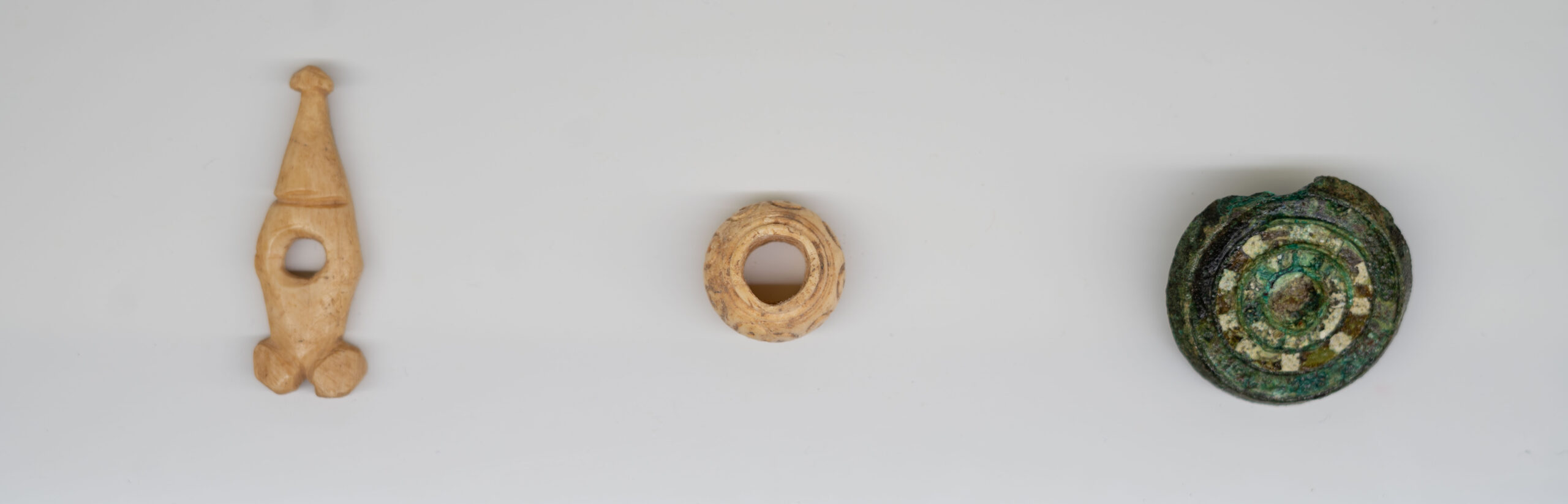
Denomination: From left to right: Bone carving, button and appliqué.
Chronology: 1st century A.D. (bone carving and button) and 5th-6th century A.D., Visigothic period (appliqué).
Place of production: Undetermined
Material: Worked bone (bone carving and button) and bronze with glass paste (appliqué).
Dimensions: 3 x 7 cm (talla); 2.5 cm diameter (button)
Use and function: Decoration (bone and button carving) and trousseau (appliqué)
Description:
Bone carving: piece cut from bone representing a phallic symbolism. It is believed that it was used as a button or decorative appliqué for clothing. It has a space in the center, as well as marks.
Button: It is believed that it is a button or an ornamental ring, we know that it was used as a trousseau either for the person or the clothing. In any case, it is a piece formed from bone, which is worked to provide ornamentation from the incisions, creating circular shapes with a point in the center. It has an oval shape, with a space in the center.
Appliqué: It is a bronze discoidal fibula, as we have said, it has a circular shape ornamented with different colors. It belongs to the Visigothic period.
Provenance of the find: Button found at the archaeological site of Castell Street, 6. Nave de la Cultura (2010). Bone carving and appliqué found at the site of Mas de Bajo. 2010