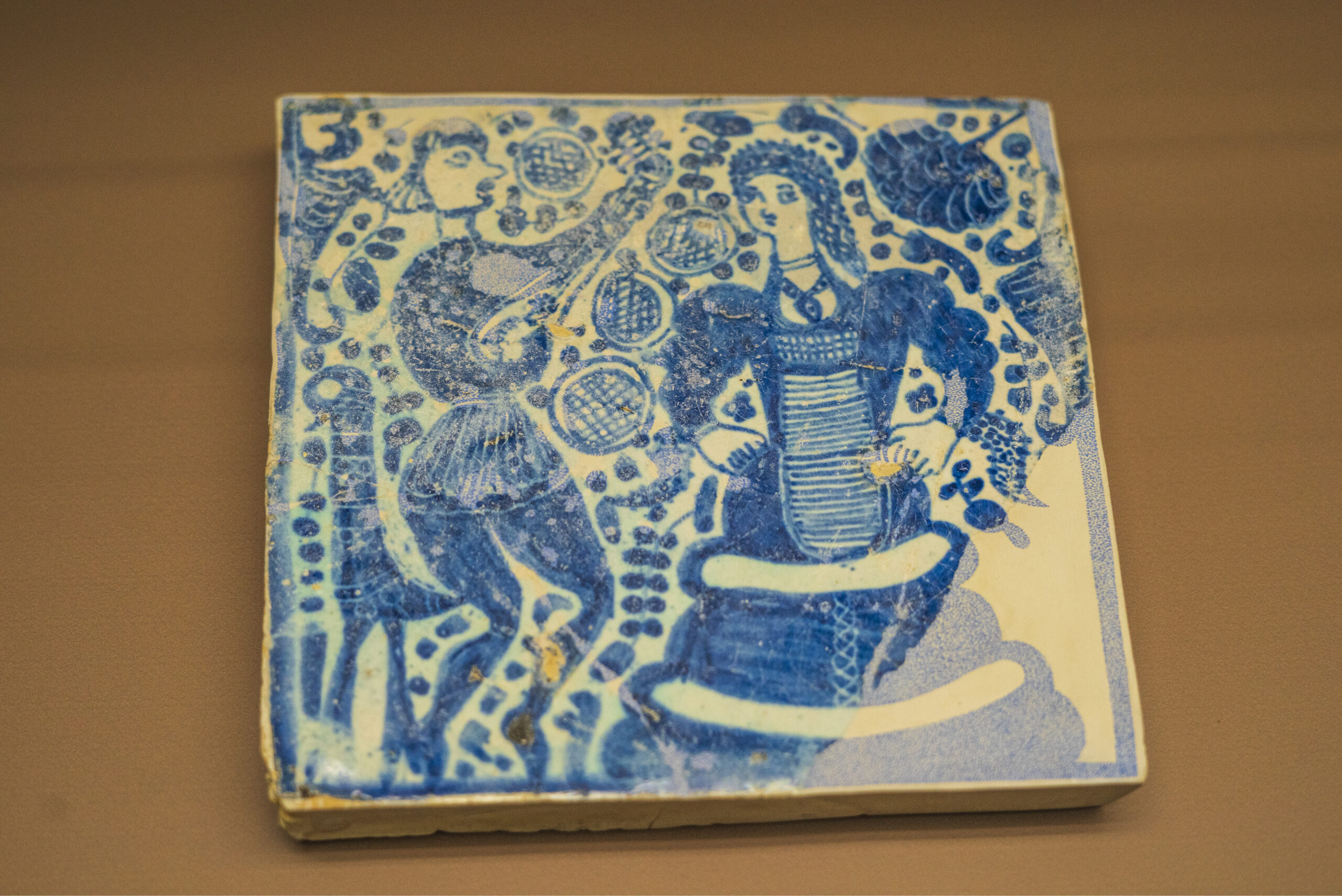
The tile of The Troubadour and his Lady
Tile, 1465 – 1475. Excavation, MCM Inv. 5224
This tile was recovered during the 2008 archaeological excavation at 18-20 Sant Vicent Street in Manises. The tile, which showed firing defects, was located at one end of the room, in a corner of poor visibility, oriented in an inverted position. Its location indicates that neither the builder of the house nor the owner gave it the true importance that the tile had, probably due to ignorance of its meaning.
The tile represents a scene outdoors where a troubadour, placed in front of a horse richly harnessed, sings to a lady accompanied by the chords of a lute. The troubadour wears a small round hood on his head, combed with short, cupped hair; he wears a jacket with a pleated skirt, of Italian influence, and stockings with sharp points. This male clothing corresponds to the fashion that was established in the kingdoms of the Iberian Peninsula from 1450 and which reached its peak in 1470.
The Lady is the one who takes center stage, she has curly hair gathered in a braid sheathed in a bonnet; she wears a dress with hoops that give amplitude to the skirt, these hoops became fashionable around 1461 because Queen Joan of Portugal wore this type of skirt to keep secret a pregnancy in which her husband King Henry IV had not intervened. On the other hand, the upper part of the dress presents an opening in rounded point that is fastened with a braid of laces, the sleeves are puffed and the cuffs let out the undulating mouths of the shirt, details of the Hispanic fashion dress that became much more exaggerated around 1500. A chain necklace with a pronounced pendant stands out above her neckline, which together with the rest of the clothing is a sign of a high social position.
The scene depicted is closely linked to court life and to the main theme of the troubadours’ poetic compositions, which was love, predominantly narrated as the respectful and submissive love of a man for a woman – sometimes married to another man – who was often inaccessible.
At the time when this tile was made in Manises, the troubadour movement had faded, but its influence was still recognizable in Valencian poets of the first half of the 15th century such as Jordi de Sant Jordi and Ausiàs March. Likewise, the existence of this presentation of the troubadour and his lady on the ceramic tile indicates that between 1460 and 1470 this image, symbol of courtly love, was still valid, although only as an allegory.